
The fire salamander is one of the most striking and mysterious amphibians worldwide. With its bold black and yellow colors, it looks like it belongs in a fairy tale. But this little creature is very real and lives in the forests of Europe. In this article, we will explore the life of the fire salamander. We will look at its habitat, behavior, diet, and the challenges it faces. You’ll know why this unique animal is so special by the end.
What is a Fire Salamander?
| Attribute | Details |
|---|
| Common Name | Fire Salamander |
| Scientific Name | Salamandra salamandra |
| Class | Amphibia |
| Order | Caudata (Urodela) |
| Family | Salamandridae |
| Native Habitat | Forests and woodlands of Europe |
| Geographical Range | Central and Southern Europe, parts of North Africa, and the Middle East |
| Physical Characteristics | Black body with bright yellow or orange spots/stripes |
| Average Size | 15–25 cm (6–10 inches) in length |
| Weight | Around 40–50 grams |
| Lifespan | Up to 20 years in the wild, 50 years in captivity |
| Diet | Carnivorous: Eats insects, worms, slugs, and other small invertebrates |
| Reproduction | Ovoviviparous: Females give birth to larvae in water |
| Behavior | Nocturnal and terrestrial; hides under logs, rocks, or in burrows during the day |
| Special Adaptations | Produces a toxic secretion from its skin as a defense mechanism |
| Conservation Status | Least Concern (IUCN), but populations are declining in some areas due to habitat loss and pollution |
| Interesting Fact | The fire salamander is often associated with myths of fire due to its tendency to hide in logs, which could ignite when thrown into fire. |
The fire salamander (Salamandra salamandra) is a type of amphibian. It belongs to the salamander family. It is known for its bright black and yellow markings. These colors warn predators that the fire salamander is toxic. The fire salamander is not a lizard, even though it looks like one. It has smooth, moist skin and no scales..
Where Do Fire Salamanders Live?
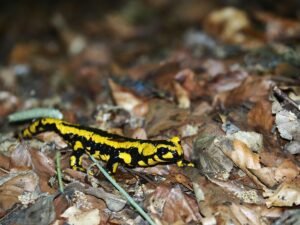
Fire salamanders live in the forests of Europe. They are found in countries like Germany, France, Spain, and Italy. They prefer cool, damp places. You can find them under logs, rocks, and leaves. They also like to live near streams or ponds. This is because they need water to lay their eggs.
Fire salamanders are most active at night. During the day, they hide in dark, moist places. They come out at night to hunt for food. Fire salamanders are shy creatures. They avoid humans and other large animals.
What Do Fire Salamanders Eat?
Fire salamanders are carnivores. This means they eat other animals. Their diet includes insects, spiders, worms, and slugs. They are slow hunters. They use their sticky tongues to catch prey. Fire salamanders have a strong sense of smell. This helps them find food in the dark.
Fire salamanders are important for the ecosystem. They help control the population of insects and other small creatures. This keeps the forest healthy.
Behavior
Fire salamanders are solitary animals. They prefer to live alone. They are not very active. They spend most of their time hiding and resting. Fire salamanders are most active during the rainy season. This is when they come out to hunt and breed.
Fire salamanders are also known for their toxicity. They have glands on their skin that produce poison. This poison is not deadly to humans, but it can irritate. The bright colors of the fire salamander warn predators to stay away.
Reproduction
Fire salamanders have a unique way of reproducing. Unlike many amphibians, they do not lay eggs in water. Instead, the female gives birth to live larvae. This is called viviparity.
The female fire salamander carries the eggs inside her body. When the eggs hatch, she releases the larvae into a stream or pond. The larvae look like tiny fish. They have gills and live in the water. After a few months, the larvae grow legs and lose their gills. They then leave the water and live on land.
Fun Facts About Fire Salamanders
Here are some interesting facts about fire salamanders:
Bright Colors: The black and yellow colors of the fire salamander warn predators that it is toxic.
Long Lifespan: Fire salamanders can live for more than 20 years in captivity.
Live Birth: Unlike most amphibians, fire salamanders give birth to live larvae.
Nocturnal: Fire salamanders are most active at night.
Slow Movers: Fire salamanders are slow and spend most of their time hiding.
Conclusion
The fire salamander is a fascinating creature. Its bright colors, unique behavior, and long lifespan make it one of the most interesting amphibians in the world. Fire salamanders play an important role in the ecosystem. They help control insect populations and keep the forest healthy.
However, fire salamanders face many challenges. Habitat loss and pollution are major threats. It is important to protect these amazing creatures for future generations.