
Introduction
Percheron horses, the majestic giants from the Perche region of France, are a breed renowned for their impressive characteristics, historical significance, and versatile uses. In this article, we’ll delve into the origins, characteristics, and many roles these gentle giants play in today’s world.
Characteristics of Percheron Horses
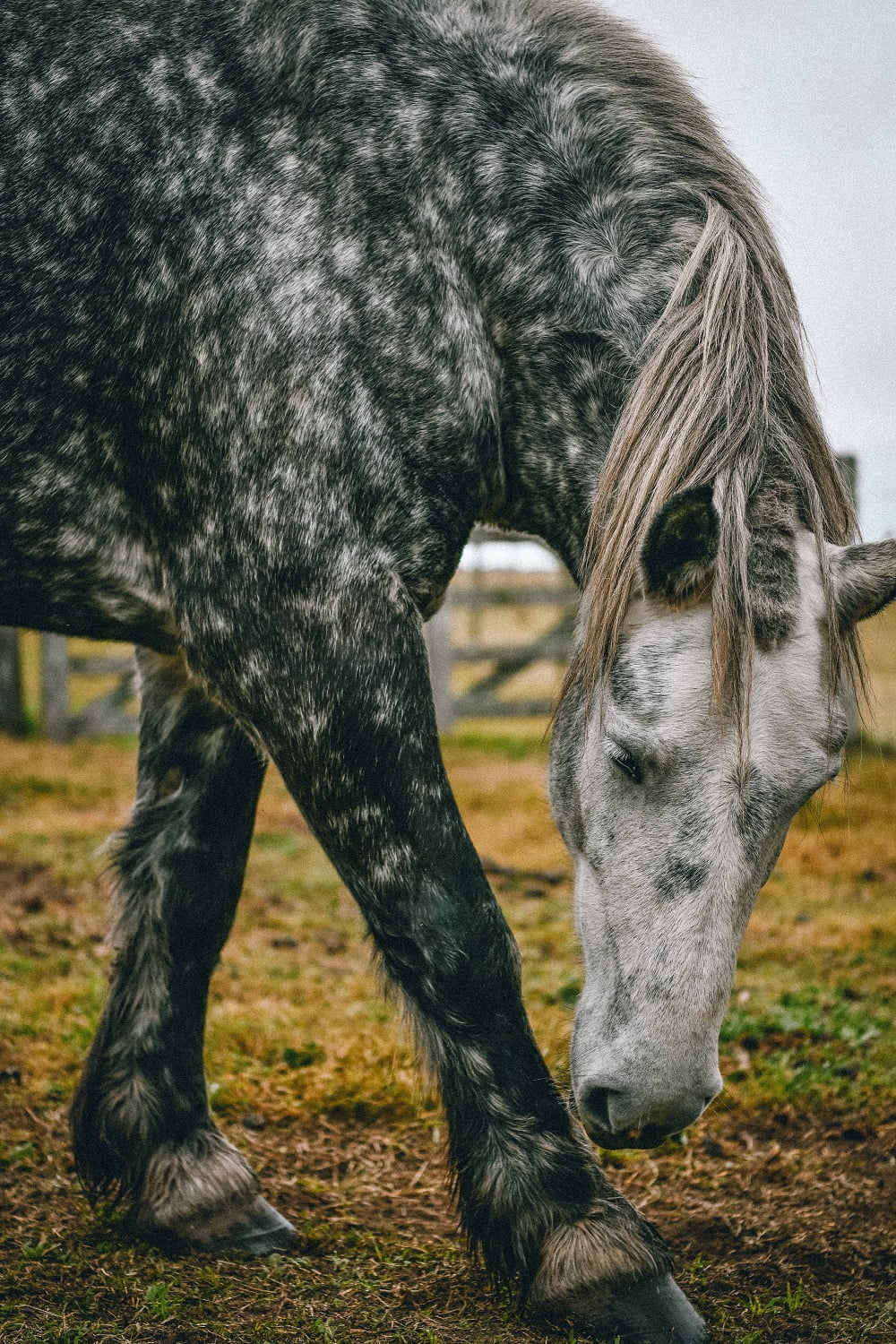
Percheron horses are renowned for their impressive characteristics. These majestic giants typically stand between 15 to 19 hands, exemplifying their immense size. Their distinctive coat colors, primarily gray and black, contribute to their striking appearance.
Historical Significance of Percheron Horses
Origins of the Percheron Breed: The Percheron breed finds its roots in the Huisne River valley, nestled within the Perche region of France. This is where it inherited its name and its legacy.
The exact ancestry of the Percheron remains a subject of speculation, shrouded in history. Several theories aim to shed light on the breed’s origins, and though the exact lineage is unclear, these stories offer intriguing insights.
- Bretons and Clovis I (496 AD): One theory posits that mares captured by Clovis I from the Bretons after 496 AD could have been a source of foundation bloodstock.
- Moors from Spain (8th Century): Another suggests that cavalry stallions from the Barb horse breed, brought by the Moors from Spain in the 8th century, might have played a role. These Moors were defeated in the Battle of Poitiers in 732 AD, and some of their horses may have found their way to Perche.
- Boulonnais Connection: There’s also the theory that the Percheron and the Boulonnais breed are closely related, and the Boulonnais may have influenced the Percheron when they were brought to Brittany.
- Oriental Influence: During the 8th century, Barb stallions were crossed with local mares, introducing more Oriental horse blood to the region. Further Arabian influence was added when Rotrou III imported horses from Castile.
- Terrain and Climate Influence: Regardless of their exact origin, breed historians concur that the landscape and climate of the Perche area significantly impacted the breed’s development.
- Literary Hints: Even literary works like the 13th-century romance “Guillaume de Dole” may contain subtle references to the Percheron breed, where the title character asks for “the Count of Perche’s horse,” perhaps indicating a horse capable of carrying an armored knight.
Development Through the Centuries
The Percheron breed went through various phases of development in response to the demands of different eras.
- 17th Century: Horses from Perche in the 17th century were smaller, typically standing between 15 and 16 hands (60-64 inches or 152-163 cm) high. They were agile and almost uniformly gray, a color favored during medieval times when French knights rode such horses.
- Diligence Horses: After the era of armored knights, the breeding focus shifted towards creating horses capable of pulling heavy stagecoaches at a fast trot. Gray horses were particularly preferred due to their visibility at night. They became known as “Diligence Horses,” named after the stagecoaches they pulled.
- Introduction of Arabians: Arabian stallions became part of Percheron breeding starting in 1760 at the royal stud at Le Pin. These additions were influential in shaping the breed.
- French Revolution: The French Revolution and its aftermath posed a challenge to Percheron breeding. By the early 19th century, the Percheron was at risk of vanishing.
- Role of American Stallions: Notable American stallions were instrumental in reviving the Percheron breed in France.
- Size Evolution: The breed’s size increased during the 19th century, with horses from various French districts imported to Perche. This transition transformed the Percheron from a coach horse, averaging 1,200–1,400 pounds (540–640 kg), into a draft horse, averaging 2,000 pounds (910 kg).
- Stud Book Creation: In 1893, the first Percheron stud book was established in France, marking an important moment in the breed’s history.
- Global Expansion: Between 1880 and 1920, Percheron breeders in France exported these horses worldwide, including to South Africa, South America, Australia, and North America.
Percherons in the United States and Great Britain
Percherons found their way to the United States in 1839 when Edward Harris II of Moorestown, New Jersey, imported them. Their journey wasn’t without challenges, but these horses played a crucial role in shaping American draft horse stock. They were instrumental in meeting the increasing demand for large draft horses in the post-Civil War era.
In the late 19th century, Percheron stallions were crossed with local mares in the United States to improve local stock, creating thousands of crossbred horses. A significant need for large draft horses in growing cities and the expanding West during this period made the Percheron indispensable.
The Percheron breed later made its way to Great Britain, where they were utilized to pull horse-drawn buses in cities. Some of these horses found their way to farmers after their bus-pulling careers, while others served in the British Army. During the Boer War, 325 Percherons were shipped to South Africa in 1900 for military use.
20th and 21st Centuries
By the early 20th century, the Percheron was one of the four major draft horse breeds, alongside the Belgian, Clydesdale, and Shire. They were renowned for their strength, energy, activity, robustness, and endurance.
The advent of mechanization post-World War II led to a decline in the Percheron population, but the breed regained interest in the 1980s. In 1988, there were 1,088 Percherons in the United States, and the Percheon Horse Association of America, with nearly 3,000 members, registered around 2,500 new horses annually by 2009.
Today, the Percheron breed continues to thrive, with a history rich in resilience and adaptation to the ever-evolving needs of different eras. It’s a testament to their enduring legacy and versatility.
Augeron Breed
The Augeron, a subtype of the Percheron, emerged during the 19th century. Mainly bred in the Pays d’Auge region, they had their own studbook registered by the Société hippique du trait augeron. They were known for their light gray color, tall stature, strength, well-built physique, and high energy.
In the late 19th century, Augerons were sold at fairs in Argences and Bayeux in Lower Normandy, highly valued for their homogeneity, beauty, and quality. In 1913, the Augeron Horse Society was formed to record these horses in a breed registry.
The Augeron population’s status has been debated due to its origin from Percherons bred in Pays d’Auge, which were modified from the original breed standard due to the influence of soil and climate over the years.
Uses
Percherons have left an indelible mark on various industries and continue to be valuable today.
- Worldwide Draft Work: Percherons are still used for draft work, both in agriculture and heavy hauling. Their strength and reliability make them a preferred choice.
- Parades and Tourism: These majestic horses are often seen in parades and used in tourism activities such as sleigh rides and hayrides.
- Urban Carriage Horses: They pull carriages in large cities around the world.
- Disneyland: The largest team of working Percherons in Europe can be found at Disneyland Paris, where they make up 30 percent of the horses in the park and pull trams on the main park street.
- Heinz Hitch: One of the most famous horse teams in the United States is the Heinz Hitch of Percherons, a familiar sight at the Tournament of Roses Parade.
- In Great Britain, Percherons are used for advertising and publicity, forestry, and farm work. They are also ridden, show jumping, and dressage. Crossbred Percherons have been used successfully in various equestrian disciplines.
- South America and Australia: Percherons have been crossbred with local mares in the Falkland Islands and northern Australia to produce larger stock horses with greater stamina. These horses are used for working stock and in mounted police units.
- World Percheron Congress: In 1978, the first World Percheron Congress was held in Great Britain and has continued annually since then.

FAQs about Percheron Horses
1: What is the origin of the Percheron horse breed?
Percherons hail from the Perche region of France and are known for their grace and strength.
2: How large do Percheron horses grow?
These majestic horses stand typically between 15 to 19 hands, exemplifying their impressive size.
3: What coat colors are common for Percheron horses?
The majority of Percherons have gray or black coats, contributing to their striking appearance.
4: How have Percheron horses contributed to history?
They played vital roles in both agriculture and as formidable war horses throughout history.
5: What’s the story behind the “gentle giants” nickname?
Despite their immense size, Percheron horses are celebrated for their docile and friendly nature.
6: Where do we see Percheron horses today?
Their versatility finds them serving in various industries, from agriculture to parades.
7: Are Percheron horses suitable for families?
Absolutely! Their gentle temperament makes them excellent companions for families and farm work.
8: What care do Percheron horses require for their well-being?
Proper nutrition, grooming, and regular exercise are key to ensuring their happiness and health.
9: Are Percheron horses easy to train?
Yes, they are known for their cooperative nature, making training a rewarding experience.
10: Are there any specific health considerations for Percheron horses?
Routine attention to their hooves, teeth, and overall well-being is essential to ensuring they lead healthy lives.
References and External Links
For further reading and information about Percheron horses, you can explore the following references and external links:
- Percheron Horse Association of America – The official website for the Percheron Horse Association of America provides insights into the breed’s history, standards, and resources for enthusiasts.
- The Livestock Conservancy – Learn about efforts to conserve rare breeds, including Percheron horses, and discover the historical context in which these horses were essential.
- Percheron Horse Origin – Explore the Wikipedia page on Percheron horses for a comprehensive overview of their origins, characteristics, and history.
Conclusion
This comprehensive article provides an in-depth guide to Percheron horses, addressing their historical significance, gentle temperament, and modern-day roles across various industries. Experience the world of Percheron horses with Pet Breed Hub.