
Wed. Apr 1st, 2026
fire salamander habitat

The fire salamander is one of the most striking and mysterious amphibians worldwide. With its bold black and yellow colors, it looks like it belongs in a fairy tale. But this little creature is very real and lives in the forests of Europe. In this article, we will explore the life of the fire salamander. We will look at its habitat, behavior, diet, and the challenges it faces. You’ll know why this unique animal is so special by the end.

Table of Contents


What is a Fire Salamander?

Attribute Details
Common Name Fire Salamander
Scientific Name Salamandra salamandra
Class Amphibia
Order Caudata (Urodela)
Family Salamandridae
Native Habitat Forests and woodlands of Europe
Geographical Range Central and Southern Europe, parts of North Africa, and the Middle East
Physical Characteristics Black body with bright yellow or orange spots/stripes
Average Size 15–25 cm (6–10 inches) in length
Weight Around 40–50 grams
Lifespan Up to 20 years in the wild, 50 years in captivity
Diet Carnivorous: Eats insects, worms, slugs, and other small invertebrates
Reproduction Ovoviviparous: Females give birth to larvae in water
Behavior Nocturnal and terrestrial; hides under logs, rocks, or in burrows during the day
Special Adaptations Produces a toxic secretion from its skin as a defense mechanism
Conservation Status Least Concern (IUCN), but populations are declining in some areas due to habitat loss and pollution
Interesting Fact The fire salamander is often associated with myths of fire due to its tendency to hide in logs, which could ignite when thrown into fire.

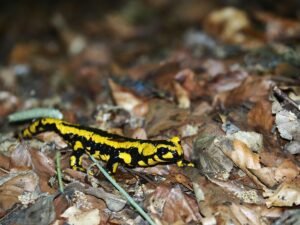
The fire salamander (Salamandra salamandra) is a type of amphibian. It belongs to the salamander family. It is known for its bright black and yellow markings. These colors warn predators that the fire salamander is toxic. The fire salamander is not a lizard, even though it looks like one. It has smooth, moist skin and no scales..


Where Do Fire Salamanders Live?
fire salamander

Fire salamanders live in the forests of Europe. They are found in countries like Germany, France, Spain, and Italy. They prefer cool, damp places. You can find them under logs, rocks, and leaves. They also like to live near streams or ponds. This is because they need water to lay their eggs.

Fire salamanders are most active at night. During the day, they hide in dark, moist places. They come out at night to hunt for food. Fire salamanders are shy creatures. They avoid humans and other large animals.


What Do Fire Salamanders Eat?

Fire salamanders are carnivores. This means they eat other animals. Their diet includes insects, spiders, worms, and slugs. They are slow hunters. They use their sticky tongues to catch prey. Fire salamanders have a strong sense of smell. This helps them find food in the dark.

Fire salamanders are important for the ecosystem. They help control the population of insects and other small creatures. This keeps the forest healthy.


Behavior

Fire salamanders are solitary animals. They prefer to live alone. They are not very active. They spend most of their time hiding and resting. Fire salamanders are most active during the rainy season. This is when they come out to hunt and breed.

Fire salamanders are also known for their toxicity. They have glands on their skin that produce poison. This poison is not deadly to humans, but it can irritate. The bright colors of the fire salamander warn predators to stay away.


Reproduction

Fire salamanders have a unique way of reproducing. Unlike many amphibians, they do not lay eggs in water. Instead, the female gives birth to live larvae. This is called viviparity.

The female fire salamander carries the eggs inside her body. When the eggs hatch, she releases the larvae into a stream or pond. The larvae look like tiny fish. They have gills and live in the water. After a few months, the larvae grow legs and lose their gills. They then leave the water and live on land.


Fun Facts About Fire Salamanders

Here are some interesting facts about fire salamanders:

Bright Colors: The black and yellow colors of the fire salamander warn predators that it is toxic.

Long Lifespan: Fire salamanders can live for more than 20 years in captivity.

Live Birth: Unlike most amphibians, fire salamanders give birth to live larvae.

Nocturnal: Fire salamanders are most active at night.

Slow Movers: Fire salamanders are slow and spend most of their time hiding.

Exploring the World of Poison Dart Frogs


Conclusion

The fire salamander is a fascinating creature. Its bright colors, unique behavior, and long lifespan make it one of the most interesting amphibians in the world. Fire salamanders play an important role in the ecosystem. They help control insect populations and keep the forest healthy.

However, fire salamanders face many challenges. Habitat loss and pollution are major threats. It is important to protect these amazing creatures for future generations.

By admin

Leave a Reply

Your email address will not be published. Required fields are marked *

We use cookies to personalise content and ads, to provide social media features and to analyse our traffic. We also share information about your use of our site with our social media, advertising and analytics partners. View more
Cookies settings
Accept
Privacy & Cookie policy
Privacy & Cookies policy
Cookie name Active

Privacy Policy for Pet Breed Hub
At Pet Breed Hub, accessible from toppetbreeds.com/, one of our main priorities is the privacy of our visitors. This Privacy Policy document contains types of information that are collected and recorded by Pet Breed Hub and how we use it.

If you have additional questions or require more information about our Privacy Policy, do not hesitate to contact us.

This Privacy Policy applies only to our online activities and is valid for visitors to our website with regard to the information that they share and/or collect in Pet Breed Hub. This policy is not applicable to any information collected offline or via channels other than this website.

Consent
By using our website, you hereby consent to our Privacy Policy and agree to its terms.

Information we collect
The personal information that you are asked to provide, and the reasons why you are asked to provide it, will be made clear to you at the point we ask you to provide your personal information.

If you contact us directly, we may receive additional information about you such as your name, email address, phone number, the contents of the message and/or attachments you may send us, and any other information you may choose to provide.

When you register for an Account, we may ask for your contact information, including items such as name, company name, address, email address, and telephone number.

How we use your information
We use the information we collect in various ways, including:

Provide, operate, and maintain our website
Improve, personalize, and expand our website
Understand and analyze how you use our website
Develop new products, services, features, and functionality
Communicate with you, either directly or through one of our partners, including for customer service, to provide you with updates and other information relating to the website, and for marketing and promotional purposes
Send you emails
Find and prevent fraud
Log Files
Pet Breed Hub follows a standard procedure of using log files. These files log visitors when they visit websites. All hosting companies do this and are a part of hosting services' analytics. The information collected by log files includes internet protocol (IP) addresses, browser type, Internet Service Provider (ISP), date and time stamp, referring/exit pages, and possibly the number of clicks. These are not linked to any information that is personally identifiable. The purpose of the information is to analyze trends, administer the site, track users' movement on the website, and gather demographic information.

Google DoubleClick DART Cookie
Google is one of the third-party vendors on our site. It also uses cookies, known as DART cookies, to serve ads to our site visitors based upon their visit to www.website.com and other sites on the internet. However, visitors may choose to decline the use of DART cookies by visiting the Google ad and content network Privacy Policy at the following URL – https://policies.google.com/technologies/ads

Our Advertising Partners
Some of the advertisers on our site may use cookies and web beacons. Our advertising partners are listed below. Each of our advertising partners has its own Privacy Policy for their policies on user data. For easier access, we hyperlinked to their Privacy Policies below.

Google

https://policies.google.com/technologies/ads

Third Party Privacy Policies
Pet Breed Hub's Privacy Policy does not apply to other advertisers or websites. Thus, we are advising you to consult the respective Privacy Policies of these third-party ad servers for more detailed information. It may include their practices and instructions about how to opt out of certain options.

You can choose to disable cookies through your individual browser options. More detailed information about cookie management with specific web browsers can be found at the browsers' respective websites.

CCPA Privacy Rights (Do Not Sell My Personal Information)
Under the CCPA, among other rights, California consumers have the right to:

Request that a business that collects a consumer's personal data disclose the categories and specific pieces of personal data that a business has collected about consumers.

Request that a business delete any personal data about the consumer that a business has collected.

Request that a business that sells a consumer's personal data, not sell the consumer's personal data.

If you make a request, we have one month to respond to you. If you would like to exercise any of these rights, please contact us.

GDPR Data Protection Rights
We would like to make sure you are fully aware of all of your data protection rights. Every user is entitled to the following:

The right to access – You have the right to request copies of your personal data. We may charge you a small fee for this service.

The right to rectification – You have the right to request that we correct any information you believe is inaccurate. You also have the right to request that we complete the information you believe is incomplete.

The right to erasure – You have the right to request that we erase your personal data, under certain conditions.

The right to restrict processing – You have the right to request that we restrict the processing of your personal data, under certain conditions.

The right to object to processing – You have the right to object to our processing of your personal data, under certain conditions.

The right to data portability – You have the right to request that we transfer the data that we have collected to another organization, or directly to you, under certain conditions.

If you make a request, we have one month to respond to you. If you would like to exercise any of these rights, please contact us.

Children's Information
Another part of our priority is adding protection for children while using the internet. We encourage parents and guardians to observe, participate in, and/or monitor and guide their online activity.

Pet Breed Hub does not knowingly collect any Personal Identifiable Information from children under the age of 13. If you think that your child provided this kind of information on our website, we strongly encourage you to contact us immediately and we will do our best efforts to promptly remove such information from our records.

Save settings
Cookies settings