
The great white shark, perhaps the most iconic predator of the world’s oceans, has long commanded both fear and admiration. Popular media often depict it as the undisputed king of marine environments, a creature whose size, power, and terrifying efficiency place it at the top of the food chain with no rivals capable of matching its ferocity. And while there is no doubt that great whites are among the most formidable hunters Earth has ever produced, this belief that they rule the oceans uncontested is not entirely accurate.
Millions of years of evolution have shaped a wide range of marine life, some of which are not only capable of matching the great white’s power but, in specific circumstances, surpassing it completely. Whether through sheer size, intelligence, specialized adaptations, or environmental advantage, several animals can defeat, overpower, or even prey upon the great white shark. This article will explore those creatures in depth, examining how they compare to the great white and why, under the right conditions, they can win in a confrontation with one of the ocean’s most feared predators.
The Orca (Killer Whale)
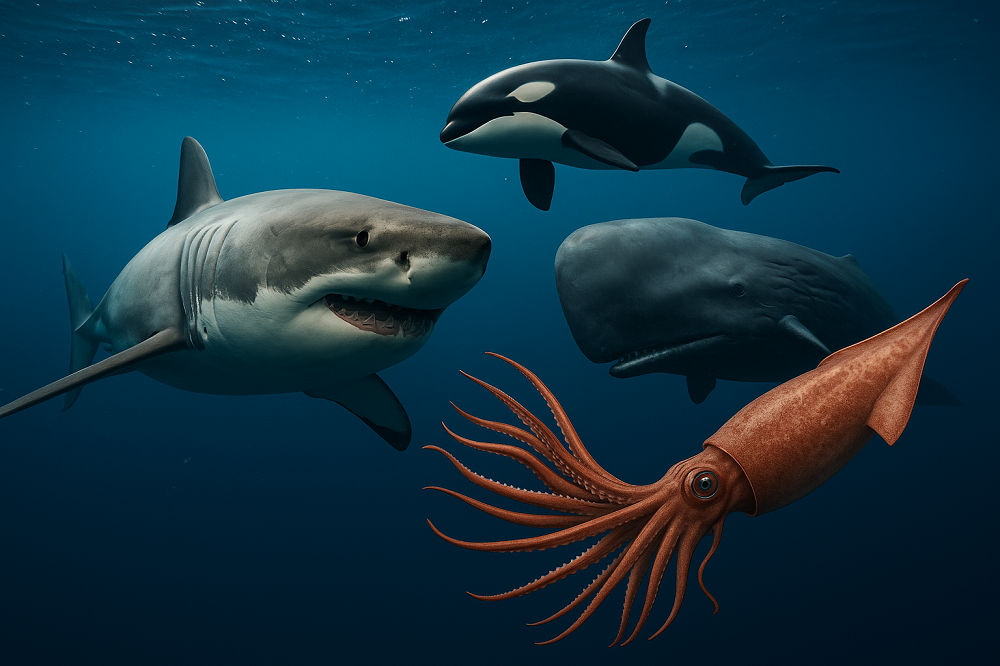
Of all the animals that encounter the great white shark, the orca stands as the most definitive example of a creature capable of not just holding its own but decisively defeating a great white in almost every conceivable scenario. Orcas are remarkable for the combination of intelligence, strength, strategy, and social cooperation they bring to hunting. They are not simply larger or stronger than great whites; they are far more adaptable and cognitively advanced, making them uniquely suited to neutralize the shark’s natural advantages.
A typical male orca can weigh between 6,000 and 12,000 pounds, dwarfing the average great white, which usually weighs a fraction of that. But the difference in size alone doesn’t explain why killer whales dominate these encounters so thoroughly. Orcas possess a level of intelligence that far surpasses that of sharks. They are capable of long-term planning, communication, and cooperative strategies that allow them to assess the weaknesses of their prey and exploit them expertly. Unlike the solitary great white shark, orcas often hunt in pods—family units that have developed distinct and elaborate hunting techniques passed down across generations. When facing a great white, orcas work together, coordinating their movements to isolate and confuse the shark.
One of the most remarkable behaviors observed in orcas is their deliberate use of tonic immobility against sharks. Orcas have discovered that if they flip a shark upside down, the shark becomes temporarily paralyzed. This state, known as tonic immobility, leaves the shark helpless and vulnerable, allowing the orca to attack without resistance. Researchers have documented several cases in which orcas specifically targeted great whites for their nutrient-rich livers. A shark’s liver is extremely high in fat, making it a valuable energy source for a large marine predator. The precision with which orcas remove this organ—often leaving the rest of the shark intact—demonstrates an almost surgical level of skill and an extraordinary understanding of their prey’s biology.
In a direct confrontation, a great white would be overwhelmed almost immediately. The shark’s hunting strategies—primarily ambush attacks from below are ineffective against such a large, organized opponent. An orca’s maneuverability, strength, and intelligence render the shark’s famous speed and bite force far less relevant. The moment an orca pod decides to target a great white, the outcome is all but guaranteed. This is why, in regions where orcas have been observed hunting sharks, great whites have been known to vacate entire ecosystems for months at a time, demonstrating that even apex predators recognize when they have met their match.
The Sperm Whale
While sperm whales are not known to hunt or engage with great white sharks regularly, their sheer physical presence makes them one of the few animals that could easily defeat a great white in a hypothetical encounter. The sperm whale is a true giant of the ocean, with males reaching lengths of up to 60 feet and weighing up to 45 tons or more. These statistics alone demonstrate the whale’s immense size advantage. Compared to the sperm whale, the great white looks small and fragile.
Sperm whales are built to withstand the pressure and dangers of the deep sea. Their massive heads, which make up nearly one-third of their body length, contain the spermaceti organ—a large, oil-filled structure that not only helps with buoyancy but also provides powerful ramming capability. Historical evidence and numerous scientific theories suggest that sperm whales may use this part of their anatomy to strike rivals or defend themselves against large predators. In a collision between a sperm whale and a great white, the shark would be utterly destroyed. The force exerted by an animal weighing tens of tons moving at even a moderate speed would crush or cripple the shark instantly.
Another factor is the whale’s immense blubber layer, which acts as natural armor. Even a great white’s powerful bite would struggle to penetrate deeply enough to do meaningful harm. Sharks rely on biting vital organs, blood vessels, or skeletal structures to subdue prey, but in the case of a sperm whale, the body is simply too dense, too thickly layered, and too massive to be affected by the kinds of attacks that work on seals, fish, or smaller sharks.
To appreciate how formidable sperm whales are, it’s worth remembering that they regularly engage in battles with giant and colossal squids—creatures with powerful tentacles and sharp hooks. These confrontations leave scars on the whales but seldom result in serious injury. An animal capable of defeating some of the deepest ocean’s largest invertebrates with only minor wounds would have no trouble dispatching a great white shark. If a confrontation did occur say, if a shark attempted to attack a whale calf, the adult sperm whale could swiftly incapacitate the shark with a tail strike or headbutt. Even a single hit from a sperm whale would almost certainly be lethal to a great white.
The Colossal and Giant Squids
When discussing animals capable of defeating a great white shark, most people imagine enormous mammals or other giant fish. Few consider the possibility that a giant invertebrate—a creature like the giant or colossal squid—might pose a legitimate threat to even the ocean’s most fearsome shark. Yet evidence suggests that squids are not only capable of fighting sharks but may sometimes injure or even kill them, especially in the depths where squids have the advantage.
Giant squids can reach lengths of up to 40 feet, while colossal squids, which are stockier and heavier, can weigh over 1,000 pounds. Unlike great whites, which rely on speed and sudden bursts of acceleration in open water, squids operate in a realm of darkness, immense pressure, and limited visibility. Their bodies are equipped with long tentacles lined with powerful suction cups, many of which are ringed with sharp, serrated hooks capable of gripping and tearing flesh. These appendages, combined with a flexible body and strong musculature, allow squids to wrap around large prey, restrict its movement, and suffocate it by blocking gills or crushing vital areas.
Deep-sea exploration has uncovered intriguing clues about squid-shark interactions. Marine biologists have found great white sharks bearing linear scars and circular marks that indicate violent struggles with large cephalopods. Such wounds are usually found on the head or dorsal region of the shark, suggesting the squid attacked from above or side angles. Although most interactions likely do not end with the shark’s death, the fact that squids can inflict significant damage shows that they are formidable adversaries.
A key factor in evaluating a squid’s ability to defeat a great white is the environment in which the encounter occurs. Great whites typically thrive in shallower waters with more light, where they can use their keen senses and superior speed to ambush prey. But as they descend into darker, colder waters, their prowess declines. The shark’s eyesight becomes less effective, its movement becomes slower due to colder temperatures, and its ability to detect electrical signals—one of its primary hunting tools is reduced by environmental noise and pressure. In such a setting, a squid, adapted to low-light hunting, can use stealth and reach to immobilize the shark.
A colossal squid, in particular, with its enormous hooked tentacles and immense strength, could feasibly wrap around a great white and restrain it long enough to suffocate it. If the squid manages to clamp its tentacles around the shark’s gill slits, the shark would be unable to breathe. Squids kill by overpowering rather than slicing; they exhaust their prey with constriction. While a great white may try to fight back, its limited maneuverability when encircled makes it vulnerable.
In open ocean conditions with good visibility and warm temperatures, the great white likely wins. But in the squids’ deep-sea domain, where the shark is disadvantaged and the squid is perfectly adapted, the squid becomes a genuine threat capable of turning the tables in a fight.
The Saltwater Crocodile
Although saltwater crocodiles and great white sharks generally inhabit different environments, there are regions—such as estuaries, river mouths, and coastal zones where their territories can overlap. In these rare intersections, the saltwater crocodile emerges as a surprisingly capable contender. Despite being smaller than the great white, the crocodile possesses a combination of physical and tactical advantages that make it a serious threat in certain situations.
Saltwater crocodiles hold the record for the strongest measured bite force in the animal kingdom. Studies estimate their bite strength to exceed 3,700 psi, although the actual forces in wild individuals may be even higher. This bone-crushing power is applied through long, cone-shaped teeth designed to grip and hold prey with unbreakable strength. In contrast, great white sharks possess a powerful bite that may reach comparable psi levels, but their jaw structure is different. Sharks do not use their bite to crush; instead, their serrated teeth slice through flesh like saws. Against a heavily armored animal such as a crocodile, this cutting strategy is far less effective.
A saltwater crocodile’s body is covered in dense, bone-like scutes known as osteoderms. These provide natural armor against attacks from other predators. A great white’s bite would have difficulty penetrating this tough hide, especially in the thickest parts. Meanwhile, if the crocodile manages to latch onto the shark, it can perform its infamous “death roll,” twisting its body with incredible force and potentially inflicting catastrophic damage on the shark’s softer body.
Another major advantage crocodiles possess is their ability to maneuver effectively in shallow or confined waters. Great whites are built for open ocean speed and wide-arc turns. In tight, shallow, or murky environments—conditions where crocodiles excel the shark loses much of its advantage. A crocodile ambushing from below or the side in shallow water could inflict significant damage before the shark could react.
However, in deeper waters, the dynamic shifts. Great whites are faster and more agile in open ocean environments. A crocodile taken out of its native habitat loses its primary advantages. Thus, the outcome of a confrontation between these two apex predators depends heavily on the environment. In shallow waters, the crocodile could very well win. In open waters, the shark would likely dominate.
Leopard Seals
When discussing animals capable of defeating great whites, leopard seals may not be the first that come to mind. They are significantly smaller, typically weighing between 800 and 1,200 pounds, and lack the size to challenge an adult great white. However, they deserve mention because of their remarkable aggression and predatory capabilities. Leopard seals are apex predators in their own ecosystems and display surprising fearlessness. Their long canine teeth, powerful jaws, and exceptional agility in frigid waters make them highly effective hunters.
While a leopard seal could not threaten a fully grown great white, it could potentially prey on juvenile sharks or confront smaller shark species successfully. Leopard seals have been documented targeting young or inexperienced sharks in Antarctic waters, taking advantage of their superior mobility in icy regions. A young great white, lacking the full strength and mass of an adult, could be vulnerable to the seal’s speed and aggressiveness. The seal’s agility and willingness to target relatively large prey put it in a category of smaller animals capable of defeating sharks under very specific conditions.
Although they are not major predators of sharks and cannot realistically defeat an adult great white, their presence demonstrates how even smaller apex predators can exert influence in their ecosystems and occasionally challenge young sharks.
Why the Great White Shark Is Powerful but Not Unbeatable
Despite the great white shark’s deserved reputation as a terrifying predator, it has several weaknesses that make it vulnerable to certain animals under the right conditions. These vulnerabilities help explain why sharks are not always victorious in interspecies confrontations.
First, great whites are primarily solitary hunters. Their strategies rely on stealth, speed, and surprise rather than teamwork or prolonged combat. This means that animals with superior intelligence or group coordination, such as orcas have an immediate advantage.
Second, their physiology makes them vulnerable in specific circumstances. The tonic immobility response that occurs when sharks are flipped upside down can render them helpless, a flaw orcas exploit with precision. Additionally, sharks breathe through their gills, which must remain unobstructed. Animals capable of restraining or blocking their gill slits, like giant squids, can effectively suffocate them.
Third, sharks are highly specialized for certain environments. In shallow or confined waters, their maneuverability suffers, giving more adaptable predators like crocodiles an upper hand. In deep, cold waters, sharks are slower and less effective, making them vulnerable to creatures like colossal squids.
Finally, great whites rely on instinctive behavior patterns that are predictable compared to the adaptable strategies of highly intelligent predators. This makes them susceptible to ambushes or coordinated attacks from species that can observe and exploit their habits.