
Beneath the wind-lashed seas that surround Antarctica, where temperatures bite, and human footprints are rare, an expedition has peeled back another page of the ocean’s long-closed book. In October 2025, an international team working with the Nippon Foundation Nekton Ocean Census and collaborators announced the confirmation of dozens of previously unknown creatures from the deep Southern Ocean, amongst them a spherical, hook-studded carnivorous sponge that the press quickly nicknamed the “death-ball” sponge. What looks at first like a bizarre curiosity actually rewrites portions of the story we tell about how life makes a living in the deep: sponges aren’t only passive filter feeders, and remote, volcanically active submarine landscapes host vibrant ecosystems packed with species that are new to science. The discovery is exciting for what it reveals about evolution, ecology, and the scale of life still waiting to be documented beneath the waves. Ocean Census
The discovery in context: a remote, volcanic laboratory
The finds came from a focused program of deep-sea exploration carried out aboard the research vessel R/V Falkor (too) and used the remotely operated vehicle (ROV) SuBastian to investigate seafloor habitats around the South Sandwich Islands — a chain of volcanic islands and trenches located far to the south of South America. The expedition deliberately targeted volcanic calderas, steep trench walls, and cold, nutrient-rich seabeds that are rarely visited by scientific teams. Working in places like the Trench North site east of Montagu Island, researchers collected nearly 2,000 specimens spanning 14 animal groups (phyla) and recorded thousands of hours of high-definition video. These amassed samples and images were then brought back to shore for verification and further analysis during a Southern Ocean Species Discovery Workshop hosted at Universidad de Magallanes in Punta Arenas, Chile. schmidtocean.org
This expedition was not an isolated voyage of curiosity. It is part of an accelerating global effort — the Ocean Census Alliance and partner institutions — to inventory ocean biodiversity and to document species ranges, life histories, and ecological relationships. The Southern Ocean in particular remains under-sampled relative to its ecological importance: its currents, cold water masses, and undersea geology have created unique habitats where endemism can be high and undiscovered lineages may persist. The 2025 expedition’s already-confirmed 30 new species are notable, but they are also likely just the beginning; only a portion of the collected material has been examined so far, meaning more surprises almost certainly remain. Ocean Census
The “death-ball” sponge: morphology, behavior and why it matters
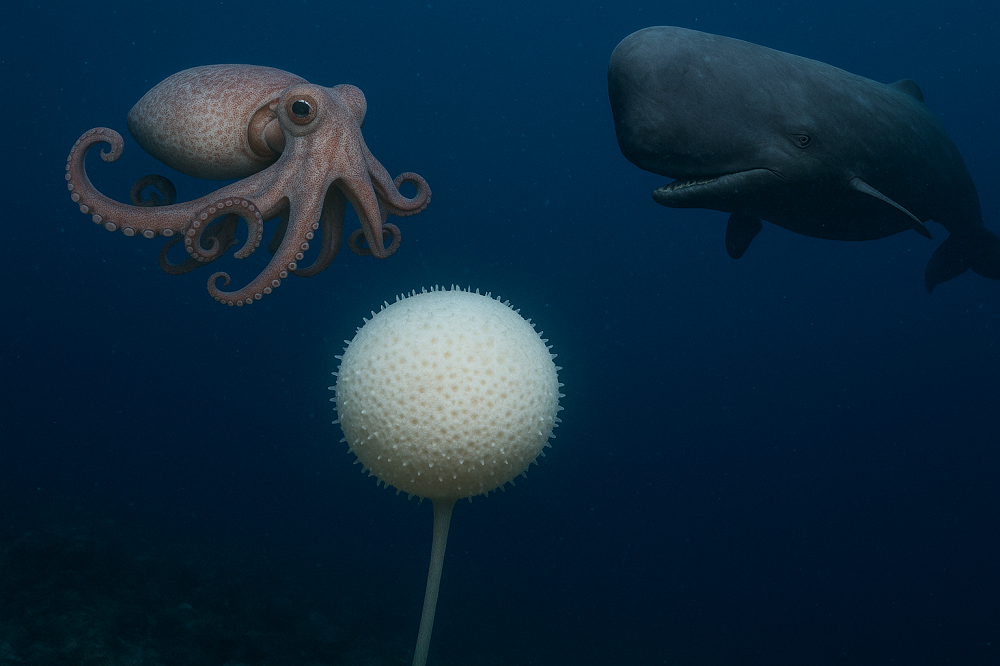
When images of the sponge were circulated, one feature dominated immediate attention: the organism’s roughly spherical central body — a ball, as the nickname suggests, covered in tiny, hook-like spicules. Sponges are, at a glance, simple animals: they filter seawater through internal channels, capture particles with collar cells (choanocytes), and are anchored to the seafloor by stalks or basal holdfasts. But a specialized family of sponges, the Cladorhizidae, defies that stereotype. Members of this family are carnivorous. Instead of relying on water currents to feed on microscopic particles, they use hooked spicules and sticky exterior structures to trap small crustaceans and other mobile prey that collide with them. The new spherical species belongs to that carnivorous lineage — provisionally described as Chondrocladia sp. nov and appears to use its array of spicule hooks to snag amphipods, isopods, and other small animals that drift or swim too close. The Guardian
Why is that surprising? Sponges were historically thought of as passive, low-energy organisms that depend on filtering microscopic food. The carnivorous sponges show a different evolutionary strategy: in nutrient-poor, cold, or structurally complex deep-sea habitats where suspended organic matter may be scarce, ambushing macrofaunal prey becomes a viable — even advantageous niche. That means the deep sea contains microhabitats in which life follows alternative rules. Recognizing carnivorous sponges and delineating their diversity helps researchers understand energy flow in the dark ocean — who eats whom, how nutrients move up the food chain, and how fragile or resilient these specialized systems might be to environmental change.
It is worth underlining that the “death-ball” name is colloquial and attention-grabbing; scientists generally use morphological descriptions and Latin binomials to avoid sensationalizing discoveries. Still, the image of a small, hooked sphere lying on the seafloor and waiting for unsuspecting crustaceans conveys an important lesson: the deep ocean is home to evolutionary experiments that are unique and, in many cases, only comprehensible when we see organisms in their living environments rather than only as preserved museum specimens.
A bounty of oddities: other newly documented life forms
The sponge headline may have grabbed popular attention, but the expedition yielded many other remarkable organisms. Among the confirmed new species and unusual records were iridescent scale worms, novel species of sea stars that expand morphological ranges for the group, armored polychaetes, previously unknown crustaceans (isopods and amphipods), and several rare mollusks including gastropods and bivalves. The team also recovered specimens that may represent new genera and potentially new families, and an array of possible black coral species and a potential new sea-pen genus remain under assessment. In short: the expedition turned up representatives from dozens of evolutionary lineages, many of which exhibit adaptations for life near vents, on steep volcanic slopes, or within cold, oxygen-poor sediments. Ocean Census
One of the most attention-grabbing pieces of footage collected during the mission was the first confirmed video of a juvenile colossal squid in its natural habitat. Colossal squid (Mesonychoteuthis hamiltoni) have been known primarily from parts of their bodies recovered on land (for example, in predators’ stomachs) and from museum specimens; live observations were extraordinarily rare. Capturing juvenile individuals on camera not only provides priceless natural-history footage but also gives scientists data about behavior, depth range, and potential prey that can inform models of life history and population structure for this iconic Antarctic cephalopod. The Guardian
Why volcanic and trench habitats are hotspots for discovery
Volcanic calderas, hydrothermal fields, and deep trench walls are physical structures that generate environmental heterogeneity. Seabed topography funnels currents, concentrates organic particles, and creates thermal and chemical gradients that certain species can exploit. Underwater volcanoes inject minerals and chemicals that support localized productivity — chemosynthetic microbes can flourish around venting sites, forming the basis of food chains that are independent of sunlight. Similarly, steep walls and rocky outcrops provide attachment points and microhabitats for sessile organisms (sponges, corals, bryozoans) and refuges for mobile species. The South Sandwich Trenches and nearby seamounts are geologically active and relatively insulated from direct human impacts, which means they can host both relict lineages and rapidly evolving taxa that exploit these special conditions.
This structural complexity explains one reason why remote seafloor exploration often produces new species: sampling effort is concentrated in areas where the odds of encountering rarity are high. Equally important is the use of modern tools — high-definition ROVs, high-throughput DNA barcoding, and precise sampling devices — which allow scientists to observe delicate behaviors, place organisms in ecological context, and determine genetic distinctiveness without causing undue damage.
Methods and verification: from ROV footage to species description
Modern deep-sea discovery is a pipeline: in situ observations recorded by ROVs like SuBastian provide behavioral context and habitat relations; physical specimens collected by carefully controlled manipulative arms are then preserved for morphological and molecular study; and specialists convene at workshops and labs to compare samples with known taxa, run DNA barcodes, and prepare formal descriptions that meet the rules of zoological nomenclature. During the 2025 Southern Ocean campaign, researchers collected both video and specimens, which were then cross-checked with taxonomic specialists at the Southern Ocean Species Discovery Workshop hosted in Chile. Less than a third of the retrieved specimens have been assessed so far, so the claim of 30 confirmed new species is likely conservative. More will be confirmed as analysis continues. Ocean Census
The combination of morphological study and genetic barcoding is critical. Many deep-sea animals show convergent morphologies: different lineages evolve similar shapes to cope with comparable selective pressures. DNA barcodes help reveal whether similar-looking animals belong to the same species or represent cryptic diversity. The Ocean Census approach emphasizes open collaboration: specimens and sequence data are shared across partner institutions so multiple specialists can evaluate the same material, reducing the chance of misidentification.
Ecology and the puzzle of energy in the deep
Carnivorous sponges provide a window into how energy is partitioned on the dim seafloor. Rather than filtering minuscule particles from suspended water, they target macrofauna — shrimp-like amphipods, tiny isopods, and other mobile invertebrates. That shift in feeding strategy has cascading implications: it alters predator–prey webs, influences nutrient cycling, and suggests microenvironments where animal-based food resources are predictably available. In volcanic regions, organic matter may be delivered episodically from vent-associated productivity or from falling detritus that accumulates in protected topographic niches; animals that can exploit such predictable patches will flourish.
The find also raises conservation questions. Deep-sea environments are increasingly targeted by industry: mineral-resource exploration (polymetallic nodules, seafloor massive sulfides), expanding fisheries, and climate-driven changes in circulation and oxygenation could all alter habitats that have existed in relative isolation for millennia. Documenting biodiversity is not only about satisfying scientific curiosity; it is the first step toward assessing vulnerability and arguing for protections when warranted.
What the discovery means for taxonomy and future research
At the taxonomic level, the discovery reaffirms that many lineages are undersampled and that museum collections, while essential, only tell part of the story. Living behavior (how animals interact with prey, symbionts, and substrates) cannot be reconstructed fully from preserved samples. That’s why ROV footage and in situ imaging are so valuable: they provide context, revealing how organisms live, move, and interact with their surroundings. As more specimens are processed, researchers will refine the phylogenetic placement of the new species, determine whether they represent new genera or families, and explore their evolutionary histories.
From a research perspective, the find generates new questions. How widespread are these carnivorous sponges — are they endemic to particular volcanoes or seamounts, or do similar forms exist across vast swathes of the Southern Ocean? What is the life cycle of the “death-ball” sponge, and how do juveniles disperse? Are there specialized predators or symbionts associated with these sponges? How do the animals’ spicule structures evolve in response to prey type and mechanical stress? Answers to these questions will require follow-up expeditions, laboratory experiments, and collaborations that unite taxonomists, ecologists, oceanographers, and geneticists.
Reputable sources and further reading
Below are the primary press releases and reporting articles that cover the discovery in detail — these are the best starting points if you want to cite the expedition or read the official statements:
Ocean Census press release, “Carnivorous ‘Death-Ball’ Sponge Among 30 New Deep-Sea Species from the Southern Ocean.” (Ocean Census / Nippon Foundation–Nekton Ocean Census). Ocean Census
Schmidt Ocean Institute — expedition pages and cruise logs for Searching for New Species in the South Sandwich Islands (R/V Falkor (too); ROV SuBastian). schmidtocean.org
The Guardian — reporting on the discovery and context for the Southern Ocean sampling effort. The Guardian
Smithsonian Magazine — overview of the species and other weird finds from the Southern Ocean expedition. Smithsonian Magazine
Popular Mechanics — accessible summary with expedition highlights and technology used (ROV footage, sample counts). Popular Mechanics
Conservation takeaways and the future of deep-sea exploration
The death-ball sponge discovery arrives at a moment when human activities are increasingly encroaching on remote ocean spaces. From warming and acidifying waters to proposals for deep-sea mining, the pressures on deep ecosystems are mounting. Discoveries like this emphasize a core scientific ethic: we should know what is out there before altering it. Documenting biodiversity is not simply an academic exercise; it forms the basis of responsible stewardship. By cataloguing life, mapping habitats, and understanding species’ ecological roles, scientists provide the necessary information to argue for protective measures and to design management plans that reduce harm.
At the same time, the find highlights the value of international, cooperative science. Large-scale surveys that combine ship time, expert taxonomists, modern molecular techniques, and ROV technology require funding and coordination that exceed any single lab or country. The Ocean Census and partner institutions created a successful blueprint for collaborative discovery — one that other ocean regions (from the Arctic to abyssal plains) would do well to emulate.