
Spider monkeys are among the animal kingdom’s most agile and intelligent primates. They are known for their long limbs, prehensile tails, and acrobatic skills. They are found in the tropical forests of Central and South America. They are named “spider monkeys” because their long, slender arms and legs resemble the legs of a spider when they swing through the trees.
Breed Overview
| Characteristic | Details |
|---|---|
| Scientific Name | Ateles (genus, includes multiple species) |
| Common Name | Spider Monkey |
| Class | Mammalia |
| Order | Primates |
| Family | Atelidae |
| Genus | Ateles |
| Species | Includes Ateles geoffroyi, Ateles paniscus, Ateles fusciceps, and others |
| Average Size | Body length: 16–24 inches (40–60 cm); Tail length: 24–32 inches (60–80 cm) |
| Weight | 13–20 pounds (6–9 kg) |
| Lifespan | 20–25 years in the wild; up to 40 years in captivity |
| Diet | Frugivorous (primarily fruit), with some leaves, seeds, and insects |
| Habitat | Tropical rainforests, primary forests, and occasionally secondary forests |
| Range | Central and South America (Mexico to the Amazon Basin) |
| Social Structure | Fission-fusion groups, typically 10–40 individuals |
| Conservation Status | Endangered to Critically Endangered (varies by species) |
| Notable Features | Long prehensile tail, no thumb, exceptional agility in trees |
| Reproductive Mode | Viviparous (live birth) |
| Role in Ecosystem | Seed dispersal, keystone species |
Species of Spider Monkeys
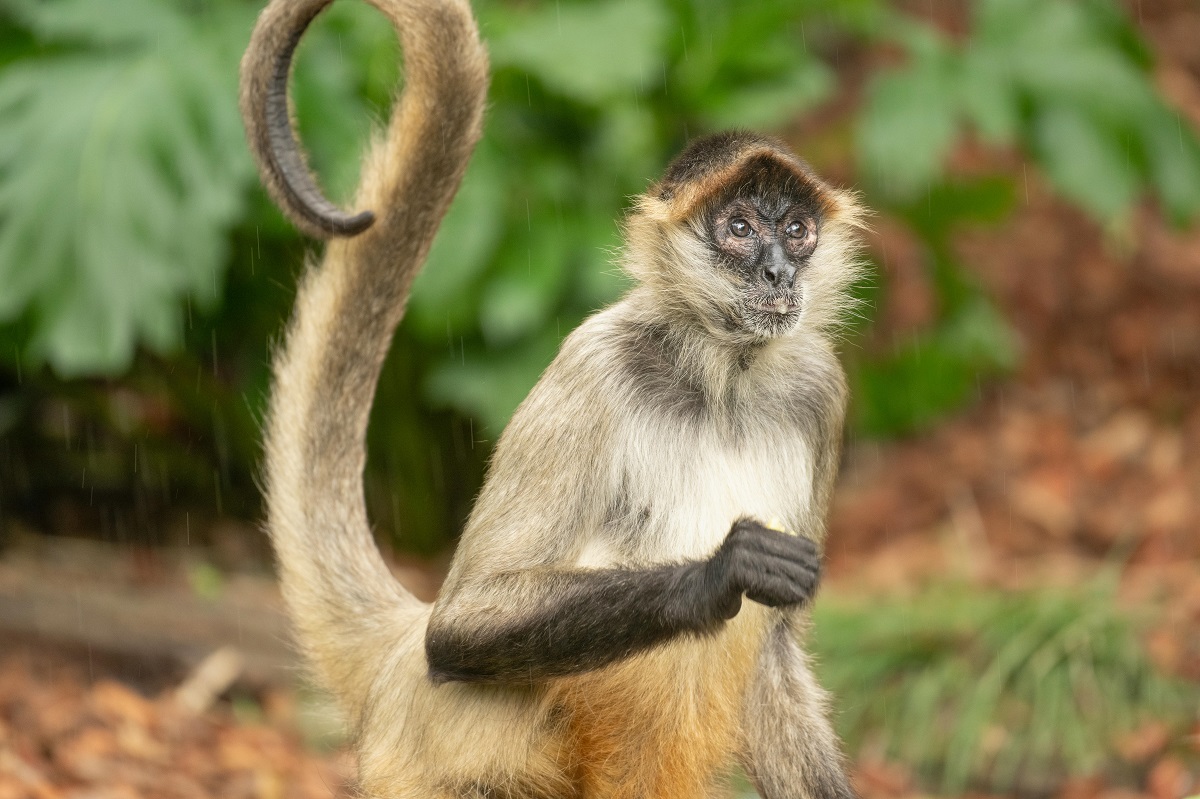
There are seven recognized species of spider monkeys:
Black-handed Spider Monkey (Ateles geoffroyi)
Black-headed Spider Monkey (Ateles fusciceps)
Brown Spider Monkey (Ateles hybridus)
White-bellied Spider Monkey (Ateles belzebuth)
Peruvian Spider Monkey (Ateles chamek)
White-cheeked Spider Monkey (Ateles marginatus)
Red-faced Spider Monkey (Ateles paniscus)
Each species has unique traits and ranges, but they all share the characteristic agility and social behavior of spider monkeys.
Physical Characteristics
They are built for life in the trees. Their bodies are designed to move effortlessly through the forest canopy.
Size and Weight: Adult monkeys are medium-sized primates. They weigh between 13 and 20 pounds (6–9 kg) and measure about 16–24 inches (40–60 cm) in body length.
Tail: One of their most distinctive features is their long prehensile tail. This tail acts like a fifth limb, allowing them to grip branches and balance while swinging. It can be as long as their body or even longer. The underside of the tail is hairless at the tip, giving it a better grip.
Arms and Legs: They have long, gangly arms and legs that help them leap and swing across large distances.
Fur: Their fur can vary in color, ranging from black and brown to gold and reddish hues. The fur is usually coarse and helps protect them from the elements.
Face: They have small, hairless faces with expressive eyes. Depending on the species, their faces are often black or pink.
Habitat
Spider monkeys are native to the tropical forests of Central and South America. They thrive in regions where tall, dense trees dominate, providing them with the canopy they need for movement and safety.
Preferred Habitat
Spider monkeys primarily inhabit rainforests, where they spend most of their lives in the treetops. They prefer primary forests, which are undisturbed and have a rich diversity of tall, mature trees. These forests provide the fruit and other resources they need for survival.
Range
Their range stretches from southern Mexico to the Amazon Basin, covering countries like Guatemala, Colombia, Brazil, Peru, and Ecuador. Each species of spider monkey may have a specific regional range within this area.
Canopy Dwellers
They are arboreal, meaning they live almost exclusively in trees. They rarely descend to the ground, as their limbs and tails are adapted for climbing and swinging rather than walking. The canopy layer provides food, shelter, and protection from predators.
Diet
They are primarily frugivores, meaning their diet mainly consists of fruit. They prefer ripe, sweet fruits that provide the high energy needed to sustain their active lifestyles. Fruits can make up to 70-90% of their diet, depending on availability.
Food Preferences
Primary Diet: Ripe fruits are their favorite food, especially those rich in sugar.
Supplementary Foods: When fruit is scarce, they eat young leaves, flowers, seeds, nuts, and occasionally insects or bird eggs.
Feeding Behavior
Spider monkeys are diurnal, meaning they are active during the day. They forage in the mornings and late afternoons, covering large areas of the forest canopy in search of food. Their prehensile tails and agile limbs allow them to reach fruits on the far ends of branches that other animals cannot access.
Water Intake
Unlike many animals, spider monkeys rarely descend to the ground for water. Instead, they drink from tree hollows, dew on leaves, or obtain moisture from their fruit-heavy diet.
[web_stories title=”false” excerpt=”false” author=”false” date=”false” archive_link=”true” archive_link_label=”” circle_size=”150″ sharp_corners=”false” image_alignment=”left” number_of_columns=”1″ number_of_stories=”4″ order=”DESC” orderby=”post_title” view=”circles” /]
Social Behavior and Group Dynamics
Highly social animals. They live in groups called troops, which can range from 10 to 40 individuals.
Fission-Fusion Groups: Spider monkeys use a fission-fusion social structure. This means that the group splits into smaller subgroups during the day to forage for food and reunite later.
Communication: They communicate using vocalizations, body language, and facial expressions. Their calls can include barks, screeches, and whoops, which help them stay connected in the dense forest.
Hierarchy: Female spider monkeys often play a dominant role in the group. They decide where the troop will forage and lead the group during travel.
Playfulness: Spider monkeys are playful creatures. Young monkeys spend a lot of time playing, which helps them develop their physical and social skills.
Life Cycle and Reproduction
Have a slow reproductive rate compared to other primates, which makes them vulnerable to population decline.
Mating: Mating is not seasonal, and females choose their mates.
Gestation: The gestation period lasts about 7.5 months.
Birth: A female typically gives birth to one baby at a time, and twins are rare.
Infant Care: Spider monkey mothers are very attentive. The baby clings to its mother’s belly for the first few weeks and later rides on her back.
Weaning: Weaning occurs at around 2 years of age, but young monkeys stay close to their mothers for several years.
Lifespan: In the wild, spider monkeys live about 20–25 years. In captivity, they can live up to 40 years.
Fun Facts About Spider Monkeys
Spider monkeys can leap distances of up to 30 feet between trees.
Their prehensile tails are so strong that they can hang upside down using only their tails.
Spider monkeys lack thumbs. This adaptation allows them to swing more efficiently through trees.
They are among the most intelligent primates, with a brain-to-body size ratio similar to that of humans.
Often form alliances within their troops, showing complex social behaviors.
Spider Monkeys in Captivity
Spider monkeys are sometimes kept in zoos or research centers. In captivity, they require a large, enriched environment to mimic their natural habitat. Zoos often play a role in breeding programs and education to promote conservation efforts.
However, spider monkeys do not make good pets. They are highly social and need a complex environment to thrive. Keeping them as pets is illegal in many countries.
Conclusion
These monkeys are extraordinary creatures that play a vital role in their ecosystems. Their agility, intelligence, and social complexity make them fascinating to study and observe.
However, they face significant threats from human activity. Protecting their habitats and raising awareness about their importance is essential to ensure their survival.