
Stingrays are fascinating aquatic creatures that belong to the cartilaginous fish group, closely related to sharks. Known for their flat, disc-shaped bodies and unique swimming style, they are a marvel of the underwater world. Found in oceans, seas, and even freshwater rivers, stingrays are diverse, adaptable, and play an essential role in marine ecosystems.
This article dives into the world of stingrays, exploring their physical characteristics, habitat, behavior, diet, and more.
Stingray Breed Overview
| Characteristic | Details |
|---|---|
| Scientific Name | Multiple species, commonly Dasyatis and Myliobatidae families |
| Common Names | Stingray, Ray |
| Class | Chondrichthyes |
| Order | Myliobatiformes |
| Family | Varies by species, including Dasyatidae and Myliobatidae |
| Genus | Multiple genera, such as Dasyatis, Potamotrygon, and Himantura |
| Species | Over 200 species worldwide |
| Average Size | Width: 1–7 feet (0.3–2.1 meters); larger species up to 16 feet (5 meters) |
| Weight | 10–800 pounds (4.5–363 kilograms), depending on species |
| Coloration | Brown, gray, sand-colored, or black; some species have patterns for camouflage |
| Lifespan | 15–25 years in the wild |
| Habitat | Coastal waters, coral reefs, estuaries, sandy or muddy seabeds, and freshwater rivers |
| Diet | Carnivorous: small fish, crustaceans, mollusks, and worms |
| Social Behavior | Mostly solitary; some species form groups during migration or breeding |
| Reproductive Mode | Ovoviviparous (live birth from eggs hatched inside the mother) |
| Gestation Period | 3–9 months, depending on species |
| Litter Size | 2–10 pups per litter |
| Defensive Feature | Venomous spine on tail used for defense |
| Conservation Status | Ranges from Least Concern to Critically Endangered (IUCN) |
| Geographic Range | Found in oceans, seas, and freshwater rivers worldwide, mainly in tropical and subtropical regions |
| Population | Varies by species; some populations are stable, others are declining due to threats like overfishing and habitat destruction |
Physical Characteristics
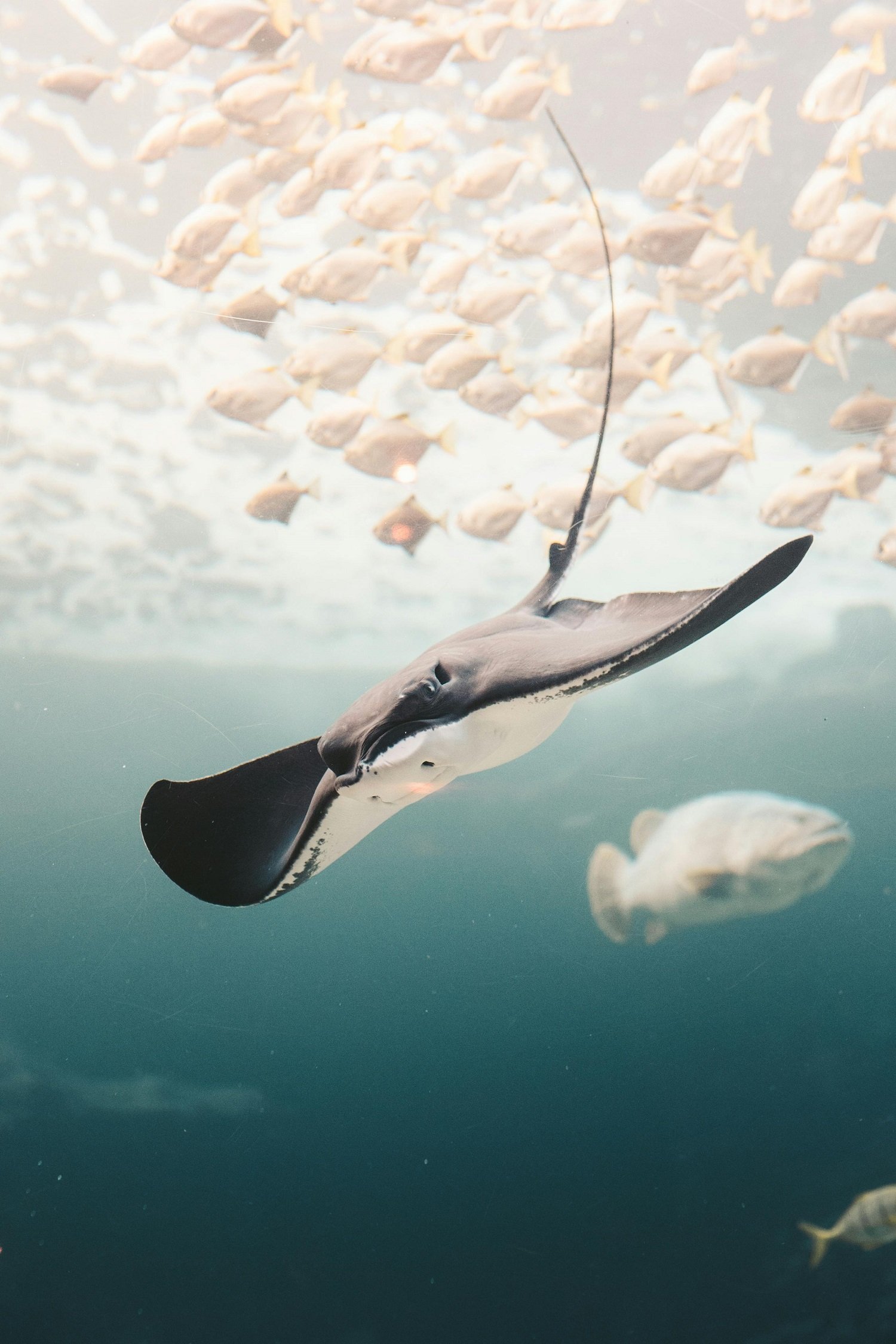
Stingrays have a flat and round or diamond-shaped body. Their appearance is defined by large pectoral fins that are fused to their head, giving them their signature disc-like shape. These fins allow them to glide gracefully through the water, resembling a bird in flight.
The stingray’s skin is often smooth but may have small bumps or scales for protection. Their coloration varies based on their environment, helping them camouflage effectively. Most stingrays are brown, gray, or sand-colored, blending perfectly with the seabed.
The tail is one of their most distinctive features. Many stingray species have a long, whip-like tail equipped with one or more venomous spines. These spines are primarily used for defense, not hunting. The venom can be painful and potentially dangerous to predators or humans, but stingrays are generally non-aggressive.
Stingrays lack a traditional skeleton made of bones. Instead, their bodies are made of cartilage, which is lightweight and flexible. They also have spiracles—small openings behind their eyes—that allow them to breathe while lying buried in sand.
Habitat
Stingrays are found all over the world, primarily in tropical and subtropical waters. They inhabit coastal regions, estuaries, coral reefs, and sandy or muddy bottoms where they can easily hide. Some species, such as freshwater stingrays, live in rivers and lakes in South America and Southeast Asia.
Many stingrays are bottom-dwellers, spending most of their time resting on the seabed. They bury themselves partially in the sand, leaving only their eyes and spiracles visible. This behavior not only helps them avoid predators but also allows them to ambush unsuspecting prey.
Behavior
Stingrays are generally solitary creatures, although they may form groups during migration or breeding seasons. Their movement is characterized by a gentle undulation of their fins, which makes them appear as though they are flying underwater.
While stingrays are peaceful and shy, they can defend themselves effectively if threatened. The venomous spine on their tail is their primary defense mechanism. However, they prefer to flee rather than fight when faced with danger.
Communication among stingrays is limited, but they use body language and chemical signals to interact with each other. For instance, males may follow a female closely during courtship, gently nudging her with their snout.
[web_stories title=”true” excerpt=”false” author=”false” date=”false” archive_link=”true” archive_link_label=”” circle_size=”150″ sharp_corners=”false” image_alignment=”left” number_of_columns=”1″ number_of_stories=”4″ order=”DESC” orderby=”post_title” view=”circles” /]
Diet
Stingrays are carnivorous and feed on a variety of prey, including:
- Small fish
- Crustaceans like crabs and shrimp
- Mollusks such as clams and snails
- Worms
Their hunting strategy is fascinating. Stingrays use their electroreceptors, located in small pits on their snouts, to detect the electrical signals emitted by prey hiding beneath the sand. Once located, they use their flattened bodies to pin down the prey and their strong jaws to crush shells or hard exoskeletons.
Reproduction
Stingrays exhibit a unique reproductive process known as ovoviviparity. This means that the eggs develop and hatch inside the mother’s body, and she gives birth to live young.
Mating occurs when a male stingray uses his claspers (modified pelvic fins) to transfer sperm to the female. After fertilization, the embryos are nourished inside the mother’s body. The gestation period varies by species but typically lasts several months.
When the young are born, they are fully developed miniatures of the adults, capable of swimming and feeding immediately. Litter sizes range from 2 to 10 pups, depending on the species.
Role in the Ecosystem
Stingrays play a vital role in maintaining the balance of their ecosystems. As predators, they control populations of small fish and invertebrates, preventing overpopulation. Additionally, their burrowing behavior aerates the seabed, which benefits other marine life.
Stingrays are also an essential food source for larger predators, including sharks, orcas, and some large fish species. Their place in the food chain highlights their importance in marine biodiversity.
Adaptations
Stingrays possess several adaptations that allow them to thrive in their environments:
Electroreception: Special organs help them detect prey buried under the sand.
Camouflage: Their coloration blends perfectly with the ocean floor.
Venomous Spine: A powerful defense mechanism against predators.
Flattened Body: Ideal for living close to the seabed.
Conservation
The conservation status of stingrays varies by species. Some, like the freshwater stingray, are listed as endangered due to habitat loss and overfishing. Efforts to protect stingrays include:
Establishing marine protected areas.
Promoting sustainable fishing practices.
Raising public awareness about the importance of stingrays in the ecosystem.
Organizations like the International Union for Conservation of Nature (IUCN) are working to assess stingray populations and implement conservation strategies.
Fun Facts About Stingrays
Stingrays are closely related to sharks, sharing similar skeletal structures made of cartilage.
Their venom is not used for hunting but strictly for defense.
Some stingray species, like the giant freshwater stingray, can grow up to 16 feet (5 meters) long.
Stingrays are ancient creatures, with fossil records dating back 150 million years.
They can live up to 25 years in the wild.
Stingrays often have symbiotic relationships with smaller fish, which clean parasites off their bodies.
Conclusion
Stingrays are remarkable creatures that captivate us with their grace, adaptability, and unique features. As an integral part of marine ecosystems, they play a crucial role in maintaining balance beneath the waves.
While stingrays are generally gentle and shy, it’s essential to respect their space and habitat. By protecting these fascinating creatures, we preserve their beauty and contribute to the health of our oceans and rivers. Through education, conservation, and sustainable practices, we can ensure that future generations have the chance to witness the wonders of the stingray.